

As clean energy markets mature, the next phase of growth will be measured by how reliably those assets perform, earn and adapt.
For years, the solar industry’s progress has been measured in capacity: megawatts installed, projects completed and clean energy added to the grid. Those metrics still matter. Solar remains one of the most scalable, cost-effective and essential resources in the energy transition. But as markets mature, demand rises and grid needs become more complex, the definition of clean energy value is expanding.
The next phase is not just about producing electricity. It is about creating assets with durable, financeable revenue.
Across the market, solar, solar + storage and standalone battery energy storage systems (BESS) are reshaping project economics. Power purchase agreements, community solar subscriptions, capacity payments, tolling agreements, grid services and revenue stacking are becoming central to how projects are valued, financed and operated.
The result is a more sophisticated clean energy landscape — one where performance is measured by revenue reliability, flexibility and long-term asset optimization.
Solar will continue to be foundational. But the market is moving toward assets that can do more than generate electrons. The strongest projects are the ones that create predictable revenue, respond to grid needs and deliver value over the full life of the asset.
Solar Remains the Foundation
At its core, solar’s value proposition remains strong. It provides clean,
cost-competitive power under long-term contracts, helping utilities, municipalities, commercial customers and community solar subscribers reduce exposure to volatile energy markets. For many projects, the PPA remains the backbone of financeability, providing the predictable cash flow needed to attract capital and support long-term ownership.
Community solar adds another layer to that foundation. Rather than relying on a single offtaker, community solar projects generate value through subscriber relationships, bill credits and program structures designed to expand access to clean energy. Predictable, contracted revenue supports investment, reduces risk and helps bring projects into operation. In markets with high renewable penetration, constrained interconnection queues, shifting demand profiles and growing electrification, the timing and shape of generation matter more than ever.
That is where storage changes the equation.
Storage Turns Generation Into Flexibility
Pairing solar with storage allows clean energy assets to become more responsive. Instead of delivering power only when it is generated, solar + storage projects can shift energy to higher-value periods, support peak demand, reduce curtailment and provide grid services that standalone solar cannot always deliver on its own.
This flexibility is changing how projects are structured. In some cases, storage is paired with a traditional solar PPA. In others, the battery is contracted separately through a tolling agreement or capacity structure. Some buyers want shaped energy products that better match their load. Others value the ability to dispatch storage for grid reliability, market participation or resilience.
That evolution is also changing the conversation with customers and investors. A solar project may be evaluated on production, contract price and offtaker credit. A solar + storage project must also account for dispatch strategy, degradation, cycling assumptions, market participation and the operational discipline required to preserve both performance and revenue. In other words, storage adds optionality.
Standalone BESS Becomes Its Own Asset Class
The rise of standalone battery energy storage systems is one of the clearest signs that clean energy value is becoming more dynamic. Standalone BESS projects are built around flexibility, dispatchability and market participation.
Depending on the market, a standalone BESS asset may earn revenue through
capacity payments, ancillary services, energy arbitrage, tolling agreements or other grid services. In some regions, a single revenue stream may support a project. In others, the investment case depends on stacking multiple sources of value.
That makes BESS both powerful and complex. The asset can respond quickly to grid needs, but revenue performance depends on market design, contracting strategy, operational expertise and
ongoing optimization.
For investors and long-term owners, this creates a new set of questions:
- Is the revenue contracted or merchant?
- How much upside is available?
- How much downside is exposed?
- Who controls dispatch?
- How are degradation and availability accounted for?
- What happens if market rules change?
As BESS grows, the market is becoming more disciplined about how those risks are allocated. The focus is moving beyond installed storage capacity to the quality of the contract structure,
predictability of revenue and ability of the asset owner to manage long-term performance.
Financeability Depends on Revenue Confidence
In every clean energy segment, the ability to finance a project depends on confidence. Lenders, tax-equity providers and investors want to understand how revenue will be generated, how
risk will be managed and how the asset will perform over time.
That is why contracted revenue remains so important. PPAs, subscription structures, capacity contracts and tolling agreements can reduce exposure to volatile merchant markets and provide the predictable cash flow needed to move projects from development into construction. Merchant upside may be attractive, especially in high-value markets, but contracted revenue often provides the foundation that makes a project financeable.
The strongest projects are the ones with revenue that can be underwritten.
This is especially important as clean energy assets become more complex. A solar project with a long-term PPA, a community solar portfolio with stable subscriber management and a storage project with a bankable tolling agreement may each create value differently. But each depends on the same fundamental principle: Durable revenue supports durable assets.
Long-Term Ownership Requires Revenue Optimization
For long-term owners, the revenue shift often begins at the financial close of the project.
Owning clean energy infrastructure over decades requires managing technical
performance, contract obligations, customer relationships, market participation and asset strategy through changing conditions. Production, availability subscriber management and dispatch decisions matter. So does the ability to identify when an asset can deliver additional value without compromising its long-term performance.
That is particularly true for storage. Batteries must be managed with an understanding of cycling, degradation, warranty requirements and market opportunity. Over-dispatching may create short-term revenue but reduce long-term value. Under-dispatching may preserve the asset but leave revenue on the table. The goal is balance: optimizing revenue while protecting the asset’s operating life.
For solar + storage and standalone BESS, this makes asset management a strategic function. The owner must understand how the project should perform in the market year after year.
Long-term ownership creates a dif- ferent lens. The question is whether a project can perform, earn and deliver value for decades.
The New Value Equation
The clean energy industry is entering a more mature phase. Scale still matters, but scale alone is no longer enough. The projects that will define the next era are those that combine clean generation, flexible performance and financeable revenue.
Solar will continue to be the foundation. Solar + storage will expand what clean energy assets can deliver. Standalone BESS will increasingly serve as a flexible infrastructure asset in its own right. Across all three, the market will reward projects that can demonstrate not only capacity, but revenue confidence.
For developers, that means thinking earlier about offtake, contract structure and long-term asset strategy. For investors, it means evaluating revenue durability alongside technology and
market upside. For owners and operators, it means managing assets with a sharper focus on performance and optimization.
The energy transition is increasingly defined by how well those assets can
perform in the market, support the grid and generate long-term value.
That is the revenue shift — and it is reshaping what clean energy infrastructure is built to do.
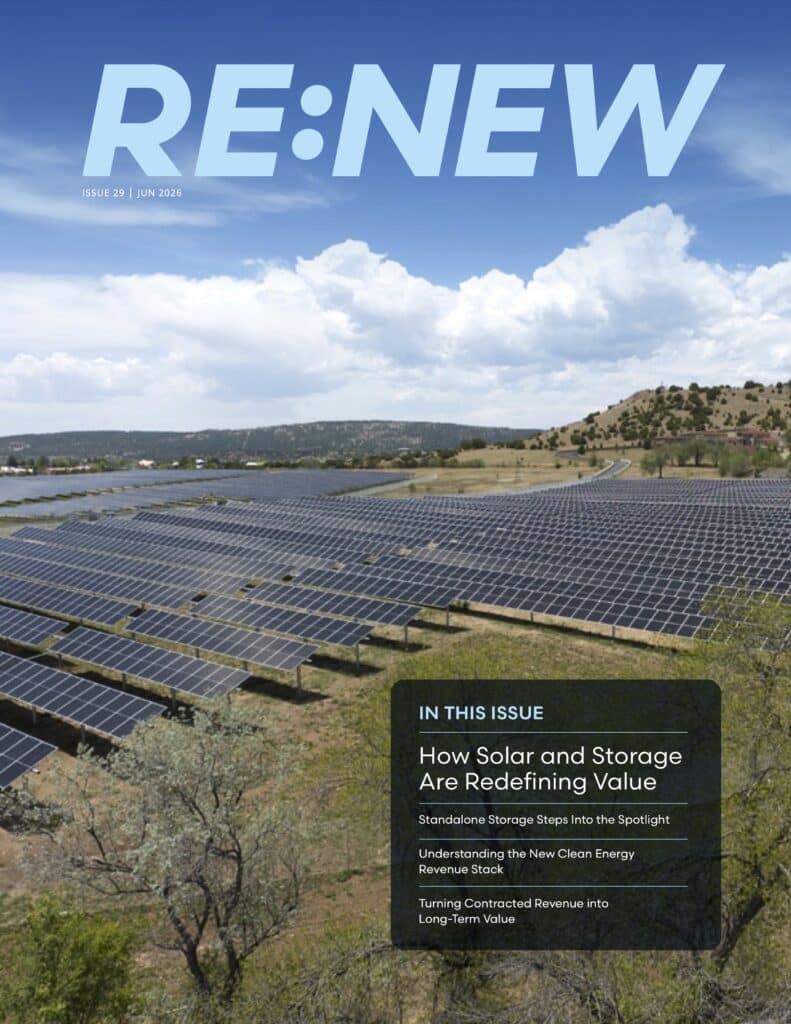
For more insights like this, explore Q2 2026 RE:NEW.
More Recent Blog Posts
Power Under Pressure: Five Forces Reshaping America’s Energy Future
October 21, 2026
Rick Berube · 7 min read
Copicut Community Solar + Storage
September 8, 2026
Standard Solar · < 1 min read
Turning Contracted Revenue Into Long-Term Value
August 17, 2026
Jay Smith · 4 min read
Understanding the New Clean Energy Revenue Stack
August 5, 2026
Standard Solar · 3 min read
Share