

The practical question for developers and investors is no longer whether power demand is growing. It is which projects can move through interconnection, permitting, financing and construction with enough certainty to become operating assets.
America’s rising electricity demand is not just increasing the need for new generation; it is changing how renewable energy projects are identified, developed, financed and delivered. For independent power producers (IPPs) and developers, the market opportunity is clear, but demand alone does not make a project viable. A successful project still requires the right site, available grid capacity, a workable interconnection path, committed customers and financing that reflects the project’s risks and value.
From our perspective as an IPP and developer of solar and storage projects, this is where disciplined development matters most. The industry does not need more speculative megawatts that look compelling in a pipeline report but cannot survive interconnection, permitting, procurement or financing scrutiny. The projects that advance will be those with clear customer demand, realistic schedules, executable grid paths and sound economics.
01
A New Asset Class Takes Shape
Companies once treated electricity as a cost to address after selecting a site. Today, energy availability is increasingly part of the site-selection decision itself. Manufacturers, data centers, logistics operations and commercial developments need to understand how much power is available, what it will cost and when it can be delivered. A site may offer attractive land, labor and incentives, but those advantages mean little if the electricity required to operate the facility is years away.
This is creating new opportunities for IPPs. Businesses are looking beyond conventional utility service for solutions that can help them secure energy, manage costs and meet operational and sustainability goals.
On-site solar, off-site power purchase agreements, community solar and battery storage can each play a role. The right structure depends on the customer’s load, location, risk tolerance and business objectives.
The conversation has shifted from simply buying electricity to building an energy strategy that supports the customer’s growth.
02
Development Begins With A Realistic Path to Market
Before committing significant capital, developers must determine whether a site can support a financeable project. That means assessing land control, permitting, local acceptance, environmental conditions, construction access, utility requirements and equipment availability.
Interconnection is often the most consequential variable. In today’s market, a queue position, study milestone, upgrade estimate or utility construction timeline can determine whether a project remains financeable. A promising site can become uneconomic if the required grid upgrades are too costly, if the utility upgrade scope changes materially or if completion of those upgrades extends beyond the project’s commercial deadlines. These delays affect more than the anticipated completion date: They can change equipment pricing, tax-credit eligibility, financing assumptions and customer commitments.
Grid-upgrade timelines also need to be treated as a development workstream, not a background utility process. The timing of feeder upgrades, substation work, protection changes, utility work permitting and utility construction crew availability can become the critical path for a project. Developers that understand those requirements early are better positioned to align customer commitments, financing milestones, interconnection obligations, permitting responsibilities and construction schedules around what the grid can realistically support.
Experienced developers evaluate grid conditions early and continue testing project assumptions as new information becomes available. Capital must be directed toward opportunities with a credible path to construction and operation, not simply projects that look attractive on paper.
A large development pipeline may demonstrate market reach, but pipeline size is not the same as project value. What matters is the ability to convert well-selected opportunities into operating energy resources.
03
Speed Matters, But Certainty Matters More
Customers want new energy resources quickly. Investors also want development schedules they can trust.
In practice, the most valuable projects are not always those promising theearliest completion date. They are the ones supported by credible schedules, clearly defined responsibilities and risks that have been identified before they become expensive problems.
Uncertainty carries a real cost. If an interconnection estimate changes, a permit is delayed or equipment must be redesigned, the project may require additional capital.
If commercial operation slips, customers may wait longer for savings, and developers may face changing financial or contractual conditions. In a higher-scrutiny capital environment, a missed assumption can quickly become a missed investment case.
That is why experienced developers avoid treating schedules as sales tools. A dependable project timeline must account for utility review, required grid upgrades, utility-controlled equipment, permitting, procurement, construction and commissioning. It should also include enough flexibility to manage the issues that inevitably arise when developing infrastructure.
For customers, lenders and investors, a realistic plan creates more value than an aggressive date that cannot be supported.
04
Distributed Energy Creates More Ways to Serve Demand
Large power plants and transmission projects remain essential, but they are not the only ways to add electricity to the system. Distributed solar can place generation on commercial rooftops, brownfields, landfills, municipal properties and other sites closer to the customers using the electricity. These projects are smaller than utility-scale facilities, but their size can also make them more adaptable to local needs.
A commercial property owner may use solar to reduce exposure to changing electricity prices. A municipality may turn underused land into a productive asset. A school district may secure savings through a power purchase agreement. A community solar project can extend those benefits to households and businesses that cannot install solar themselves.
Battery storage further expands the range of potential solutions. Storage can help customers manage peak demand, shift energy use and improve the value of solar production. In some markets, it can also generate revenue by responding to grid needs.
As customers place greater value on reliability and business continuity, distributed energy is also becoming part of a broader resilience strategy, including microgrid-ready infrastructure where site conditions and economics support it.
For an IPP, the opportunity is to match the right project structure to the customer need, site conditions and market requirements it is intended to serve.
05
Long-Term Contracts Create Greater Cost Certainty
Businesses are increasingly looking for more control over energy costs. Renewable energy agreements can provide greater visibility and reduce exposure to price volatility.
Because an operating solar project has no fuel cost, its long-term pricing can be more predictable. A well-structured power purchase agreement can allow businesses, municipalities or institutions to secure that pricing over an extended period without owning or operating the project itself.
The IPP finances, develops and operates the project while the customer purchases the electricity or receives the associated financial benefits under an agreed structure. This allows the customer to focus on its core operations while gaining access to renewable energy without assuming responsibility for developing the asset.
The value extends beyond a lower price in the first year. Greater cost certainty can strengthen operating budgets, support expansion planning and reduce exposure to future market volatility.
For investors, contracted projects can provide dependable revenue. For customers, they can turn energy from an unpredictable expense into a more manageable business input.
06
Strong Development Creates Stronger Projects
The decisions made during development directly affect whether a project can be financed, constructed and operated successfully. Site conditions, equipment selection, engineering quality, utility requirements and construction planning all influence project performance. Addressing these considerations early helps reduce risk, control costs and create a more dependable path to commercial operation.
For an IPP and developer, the objective is to structure projects that work for the customer, the market and the local grid. That requires balancing near-term development realities with long-term operating value.
Ultimately, successful development is about turning a viable opportunity into a functioning energy resource that performs as expected.
07
Capital Is Moving Toward Execution
Strong demand has attracted substantial investment to solar and storage, but capital remains selective. Investors and lenders are paying close attention to interconnection status, equipment sourcing, tax-credit qualification, customer creditworthiness and construction risk. A project may serve a compelling market need and still struggle to secure financing if those fundamentals are unresolved.
That scrutiny reflects the realities of energy infrastructure. Projects require significant upfront capital and must be structured to withstand changing market conditions, construction challenges and policy uncertainty.
For developers, this means resolving major risks before seeking construction capital. For IPPs, it means evaluating opportunities based on their ability to advance from development into operation.
The market increasingly rewards execution: the ability to take a project from site identification through financing, construction and commercial operation.
Turning Demand Into Operating Projects
The expansion of America’s energy economy will require an enormous amount of new generation and storage. Yet the industry’s success cannot be measured only by the number of projects announced or megawatts proposed. The more meaningful measure is how many projects reach operation and begin delivering reliable, affordable electricity.
For IPPs and developers, that requires choosing markets carefully, underwriting risk realistically and developing projects around identifiable customer and grid needs. It means maintaining discipline even when demand is strong and recognizing that a viable energy project must work technically, commercially and financially.
Electricity demand is creating significant market opportunities, but lasting value will come from projects that are selected carefully, underwritten realistically, financed responsibly and executed through operation.
The market will increasingly favor platforms that can combine development discipline with long-term ownership, operational capability and access to capital.
That is how independent power producers help build the energy economy: not by announcing demand, but by converting it into operating projects that support business growth, strengthen communities and deliver durable value.
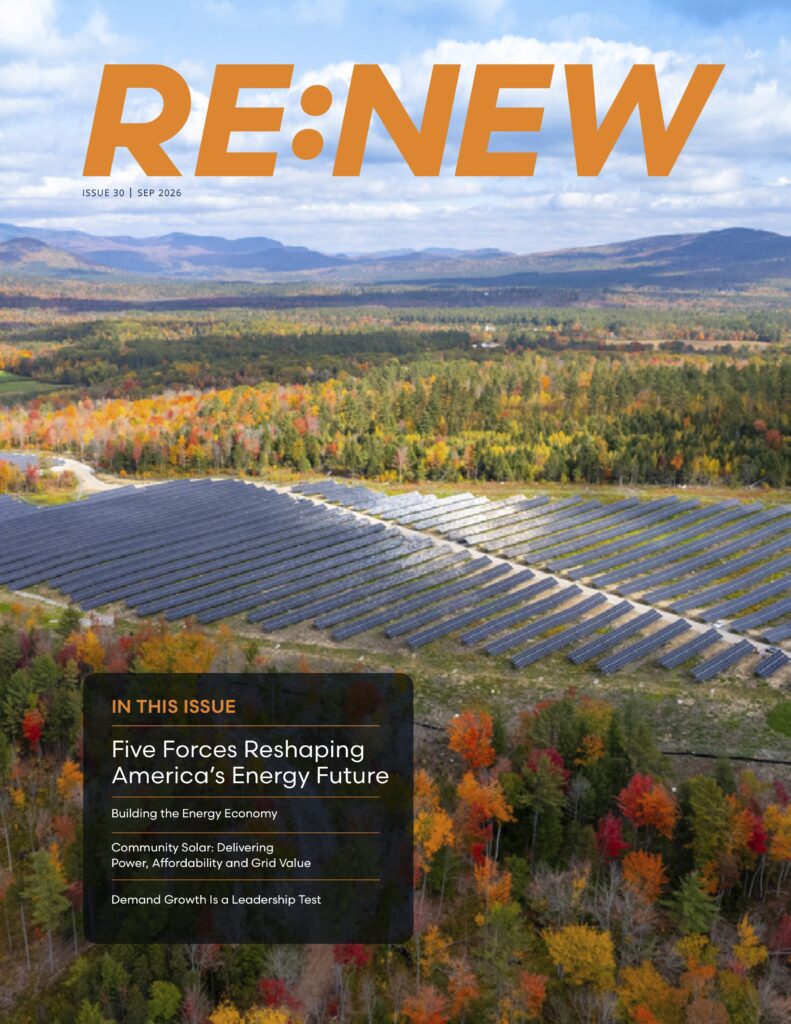
Q3 2026 RE:NEW.
More Recent Blog Posts
Power Under Pressure: Five Forces Reshaping America’s Energy Future
October 21, 2026
Rick Berube · 7 min read
Copicut Community Solar + Storage
September 8, 2026
Standard Solar · < 1 min read
Turning Contracted Revenue Into Long-Term Value
August 17, 2026
Jay Smith · 4 min read
Understanding the New Clean Energy Revenue Stack
August 5, 2026
Standard Solar · 3 min read
Share