
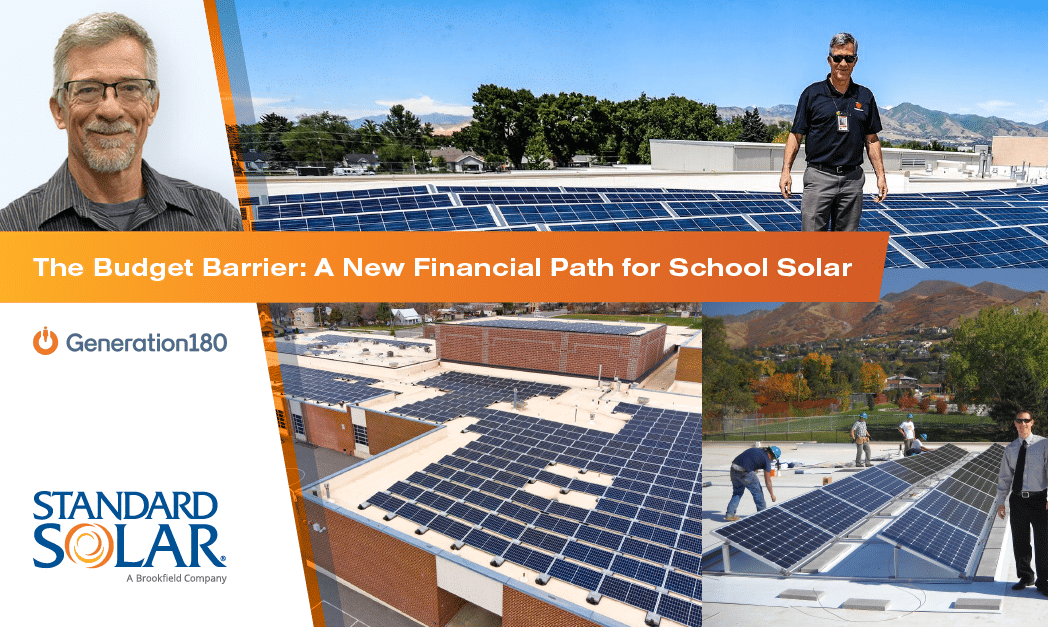
This piece concludes our series based on insights from Energy Advisor Greg Libecci of Generation180.
For most school districts, the biggest barrier to a large-scale energy project isn’t the mission — it’s the money. Convincing reasons, from improving student health to creating a “real-world classroom,” are often stopped by one simple question: How do we pay for it
For many district leaders, the upfront cost seems like an insurmountable barrier. However, complex financial hurdles are solvable. With the right strategy and the right partner, large-scale projects can be achieved with little to no impact on a district’s capital or operational budgets — and often at no new cost to taxpayers.
The “Budget-Neutral” Case Study: A $29 Million Success
Greg Libecci, now Energy Advisor at Generation180, faced this exact funding barrier during his time at Salt Lake City School District. He knew that to get a massive $29 million energy project approved, the standard funding paths were not ideal.
Typically, districts are faced with a difficult choice for funding such large-scale projects: either pull from limited capital budgets, money that is needed for other student-focused priorities, or attempt a complex public bond measure. Both options are fraught with barriers; public bond measures can face resistance, and as Libecci emphasized, a $29 million project “isn’t going to happen” out of a normal capital budget.
Libecci provides a clear case study in a different, more effective path. He successfully managed a $40 million portfolio of energy projects, including the $29 million phase, which was achieved with no additional cost to taxpayers.

Caption: Greg Libecci, Energy Advisor at Generation180 and former Sustainability & Energy Manager at Salt Lake City School District.
The projects were funded through a specific financial mechanism — a Tax-Exempt Lease Purchase (TELP) agreement with an Energy Service Company (ESCO). This “budget-neutral” framework was simple in principle: the ESCO guaranteed that the new, efficient technology (like new solar arrays, LED lighting and new HVAC) would save the district a specific amount of money. Those guaranteed savings were then used to pay the loan for the project over 20 years.
The result: The district received massive upgrades while its budget remained neutral. The money used to pay the loan was the same money that would have otherwise gone to the utility company. It proved that even multi-million dollar financial hurdles are addressable.
The Immediate and Long-Term Payoff
This budget-neutral model delivers benefits on two timelines. Immediately, the district gains the full value of the modern infrastructure. In Salt Lake City, this meant new LED lighting and modern, all-electric HVAC systems, which improved the classroom learning environment and enhanced community health by reducing on-site fossil fuel combustion.
Long-term, after the 20-year loan is paid, the financial savings are no longer used for financing. That money is then freed up to go directly into the district’s operational budget, where it can be reinvested in educational programs, new technology or other student-focused priorities.
From Concept to Contract
Libecci’s work proves the concept is possible. The role of a partner like Standard Solar is to make it a contractual reality.
As a strategic financial partner, we navigate this complexity for districts. We are a partner that develops, funds and operates projects long-term. This means we have the financial strength and in-house expertise to manage complex funding paths, turning the budget-neutral idea into a concrete, financed project. We handle the financial hurdles, allowing district leaders to focus on their core educational mission.

Caption: Solar installation at Hillside Middle School, Salt Lake City School District
The Budget-Neutral Model in Action
As a recognized leader in school sustainability with over 130 projects deployed across 10 states (40+ MW), we understand that maximizing solar potential relies on financing capability, technical support and strategic alignment.
Our recent 17-megawatt (MW) portfolio for Maryland’s Montgomery County Public Schools (MCPS) and Prince George’s County Public Schools (PGCPS) is a clear application of this funding approach. These projects were made possible through sophisticated funding paths.
We successfully navigated specific Maryland programs like Aggregate Net Energy Metering (ANEM) and leveraged cooperative contracting tools via the Metropolitan Washington Council of Governments (COG). This strategic financial approach allowed us to get these projects built with no capital outlay for the schools, proving that we can make large-scale solar fiscally achievable for districts.
Ready to make your project fiscally achievable? Connect with us to learn more about Standard Solar’s leadership in commercial and community solar and our project support from financing to operation.
Visit our blog landing page to read the other parts of this series featuring insights from Energy Advisor Greg Libecci of Generation180.
More Recent Blog Posts
New Mexico Community Solar is Bringing Clean Energy Savings and Equity
March 23, 2026
Standard Solar · 2 min read
From the Field: What It Really Takes to Get Projects Over the Line
March 9, 2026
Seth Adams, Senior Vice President of Construction · 5 min read
Massachusetts: A Visionary State in Community Solar Growth
February 13, 2026
Standard Solar · 3 min read
Unlocking Student Imagination with Solar Energy
January 20, 2026
Standard Solar · 4 min read


Share