
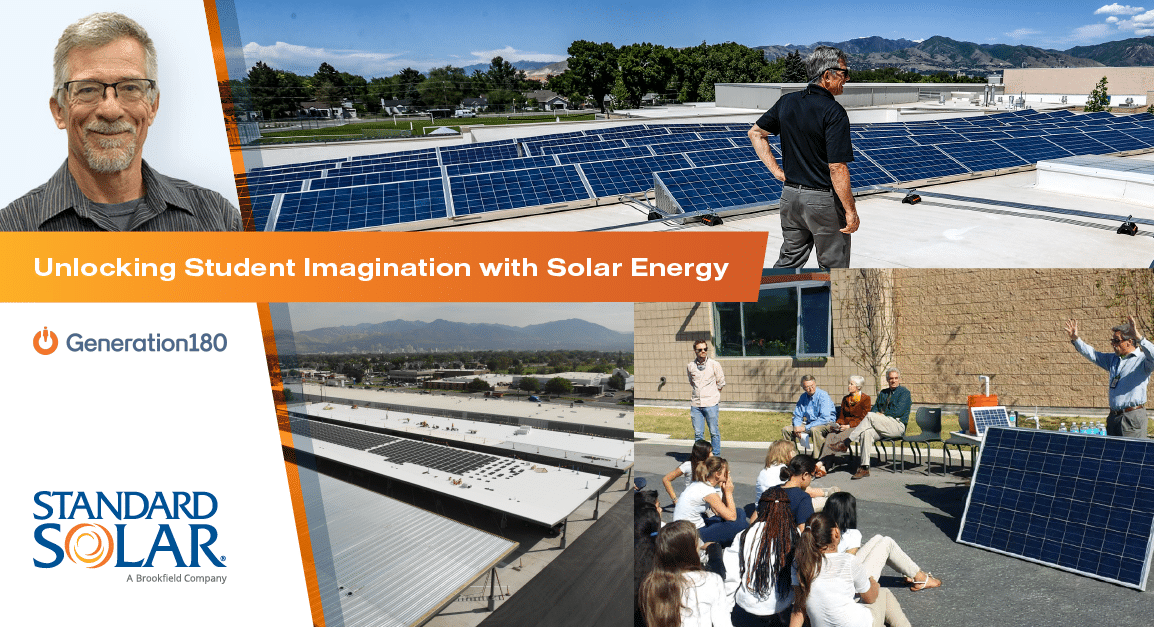
This piece continues our series based on insights from Energy Advisor Greg Libecci of Generation180.
Installing solar panels is just the start. Real impact comes when districts go beyond kilowatts and savings, using the array as an educational tool. Connecting the rooftop asset to the daily curriculum transforms solar from passive infrastructure into an active “real-world classroom,” building lasting support from students, faculty and the broader community.
A Lesson in Ownership: The “Reduce the Juice” Program
This real-world classroom approach — and the community support it builds — was put into action by Greg Libecci, now Energy Advisor at Generation180. As the former Sustainability & Energy Manager for Salt Lake City School District, Libecci was responsible for large-scale results, managing a $40 million portfolio of combined solar installations and energy saving measures, which is expected to reduce CO₂e by greater than 35%.
He knew that infrastructure was only half the story and proved this concept with a program he developed called “Reduce the Juice.” Instead of just telling students to conserve, the program gave them a direct role in the process. Libecci’s program had fifth-grade students walk down to the school’s utility meter. They learned how to read it, took a reading and then returned 24 hours later to calculate the school’s total daily energy consumption. Armed with this data, the students created their own awareness campaign with posters and an assembly. They held a “Reduce the Juice Day,” encouraging everyone to turn off non-essential lights and equipment, and the result was a 12% reduction in the school’s energy use in a single day.

Credit: Salt Lake City School District, 2040 Sustainability Action Plan
The students did the math. A 12% reduction for one day was a great start, but they quickly saw the larger potential: What if they did this every day? What if all 40 schools in the district joined in? The numbers became immense, transforming an abstract concept into real financial and environmental savings. “When it’s student to student, it really has more impact than anything,” Libecci said. This program gave them a clear stake in their school’s environmental footprint.
This kind of creative engagement is key. Libecci also recalled how a solar contractor captivated students at a media event by bringing small, solar-powered bugs. When the sun hit the panels, the bugs jumped around and the kids were thrilled — a simple, tangible lesson that instantly captured their imagination.
Bridging the Gap: From Installation to Integration
Solar installations are valuable assets, but educators often struggle to translate them into lesson plans. Traditional curricula rarely cover topics such as real-time energy data, climate science or grid optimization, making it challenging for even enthusiastic teachers to connect solar arrays to math or science lessons. This challenge is worsened by teachers’ packed schedules and strict lesson plans. Last-minute opportunities, such as visiting the installation, often do not fit into a fixed curriculum. It’s not due to a lack of interest but the practical limits teachers face daily.
Libecci is now advocating for solutions to this challenge, promoting the idea of a dedicated “sustainability coach” or a full-time curriculum staff member focused on sustainability. This role would bridge facilities and classrooms, making it easy to integrate sustainability projects into lessons at the right moment.
He also supports the development of on-demand digital resources, such as webinars with interactive modules, that cover a project’s full lifecycle — from economic considerations and pre-construction to various build stages and final operation. Tailored by grade level, these resources allow teachers to use them flexibly, overcoming curriculum timing challenges.
From Concept to Classroom
This is where a partner’s role becomes clear. We understand that district leaders need to focus on education, not on the complexities of energy policy or project finance. As a partner that develops, funds and operates these systems long-term, we handle the complex financial and logistical hurdles to complete the project. We help build the classroom immediately.

Caption: Student group that advocated for school district commitment to 100% clean energy.
The “Classroom” in Action
Standard Solar brings deep national experience to educational projects, having supported over 130 commercial and community solar installations for schools across 10 states. This large footprint ensures that our partners benefit from the expertise required to turn any installation into a curriculum asset.
Our recent projects for Montgomery County Public Schools (MCPS) and Prince George’s County Public Schools (PGCPS) are examples of these real-world classrooms coming to life. Rooftop arrays at schools like Tilden Middle and Clarksburg High serve as hands-on STEM learning tools. These systems provide real-time data, letting students track megawatt-hours and connect science and math lessons to clean energy’s true impact.
This is how you create long-term sustainability advocates — students who are not just passionate about the environment, but who are also literate in the data, the economics and the real-world application of clean energy technology. A solar panel on a roof saves money. A solar panel connected to the curriculum builds a generation of advocates.
Ready to build a “real-world classroom” at your school? Connect with us to learn more about Standard Solar’s leadership in commercial and community solar and our project support from financing to operation.
Visit our blog landing page to read the other parts of this series featuring insights from Energy Advisor Greg Libecci of Generation180.
More Recent Blog Posts
New Mexico Community Solar is Bringing Clean Energy Savings and Equity
March 23, 2026
Standard Solar · 2 min read
From the Field: What It Really Takes to Get Projects Over the Line
March 9, 2026
Seth Adams, Senior Vice President of Construction · 5 min read
The Budget Barrier: A New Financial Path for School Solar
February 24, 2026
Standard Solar · 3 min read
Massachusetts: A Visionary State in Community Solar Growth
February 13, 2026
Standard Solar · 3 min read


Share